Thousands of payments crowd down a funnel into a single queue. As you scroll, the queue opens into separate lanes, one for each owner, and the payments flow freely. In the middle, away from every lane, sits a committee of seven; now and then five of them sign one payment and a seal appears: a certificate issued away from the payment path.

Your online wallet

Start doing business with the world.

Freeing your business and your ideas to fly over all barriers. Post-quantum security with lightning-fast transactions at your fingertips.

Problem one

The serialisation tax

Most ledgers push every transaction through one global order. Capacity, fees and delay are then set by the length of that queue, not by how many transactions actually conflict.

51.7%independent, still waiting.

In recent Ethereum blocks, 51.7% of transactions touched nothing that another transaction in the same block touched. The longest conflict chain is about 16–17% of a block. Everything else waited in the same line anyway.

Anjana & Ravi, arXiv 2505.05358

Problem two

The queue for sale

Whoever controls the order, or sees it first, can trade around everyone else. Society then pays a second time to police it.

Choose a mode, then submit a swap.

Your place in line is printed on your receipt.

~20% of equity trading volume is in latency races. A tax of about 0.5 bp, about $5 billion a year in global equities.Aquilina, Budish & O'Neill, Quarterly Journal of Economics, 2022

60–90k Ethereum sandwich attacks a month. About $60 million a year taken from traders, Nov 2024–Oct 2025.EigenPhi, via Cointelegraph

What this rail covers

The ordering guarantee applies to owner-signed transfers. Trading venues on Bhoomi, such as the order book and auctions, are sequenced today by a trusted custodian, so a venue operator still decides the order of what it receives. That is listed under "What is not built yet".

In "Today" mode a bot's tiles jump in front of and behind your swap and the price you get worsens. In "Bhoomi transfer rail" mode your transfer's position is derived from its own signed content and nothing can move in front of it.

How it works

From a key on your phone to a certificate

  1. 1 / 4

    Keys born on your device

    Your wallet makes its keys in your browser. A 2-of-3 backup replaces the seed phrase: one share on your device, one in your own cloud backup, one sealed on the node under your recovery PIN. Your identity key is post-quantum (ML-DSA-65). Each payment is signed with Ed25519.

  2. 2 / 4

    Sign and commit at an origin

    You sign a payment and send it to any node. That node commits it with nothing but your signature. There is no global queue on the path, no mempool and no fee auction.

    15 msmedian to commit at the origin · 31 honest payments, one LAN, 24 Sep 2026.

  3. 3 / 4

    A certificate, when someone needs one

    A seven-member committee countersigns away from the payment path. A recipient who needs finality asks for a certificate, and 5 of 7 signatures make one. The quorum moves to the recipient who needs finality. It is not removed.

    314 msmedian to a 5-of-7 certificate on demand (392 ms p95) · 31 honest payments, one LAN, 24 Sep 2026.

  4. 4 / 4

    A double-sign is caught

    If an owner signs two conflicting payments, every node ends up holding the proof. The signer is blocked, and a node that took the losing payment repairs itself. A double-sign is detected, contained, certified and repaired. It is not prevented.

    6live double-signing drills · Seven nodes, three operators, two drills across operators' hosts, 9–24 Sep 2026. Every fork produced a proof. From drill 3 the signer was contained and the losing node repaired itself.

Every batch is ordered from signed content alone: no mempool, no fee or priority term, and gossip only after commit. No one can change the order of two owner-signed transactions they did not sign.

Finality record, 24 Sep 2026 · Drill record

Proof

Measured, with the conditions attached

Each figure carries the conditions it was measured under and where it comes from. A figure without its conditions is not on this page.

12,215

committed transactions per second

One node, owner authentication and write-ahead-log fsync on, 256 concurrent submitters, 27 Jul 2026. Not a network rate. · Code extraction report, 24 Sep 2026, G-C02
3,497

committed per second through one origin

Seven-node, three-operator drill network, 16 Sep 2026; all seven nodes agreed within 90 s. · Research paper under review, §7
15 ms · 314 ms

median to commit at the origin · median to a 5-of-7 certificate on demand (392 ms p95)

31 honest payments, one LAN, 24 Sep 2026. · Finality record, 24 Sep 2026
446

declared security settings

Strict mode: the node refuses to start if one differs. · Code extraction report, 24 Sep 2026, E-M7
465,263

lines of production code · 4,000+ automated tests · Apache-2.0 licence

At commit 1cdd718e. · Code extraction report, 24 Sep 2026, E-A02
2 + 1

first live cross-ledger FX settlements: 2 settled and 1 refunded, balances conserved

Public testnet, 7 Sep 2026; the dollar leg was read from Stellar by the node. · Code extraction report, 24 Sep 2026, G-E01

6 live double-signing drills

Seven nodes, three operators, two drills across operators' hosts, 9–24 Sep 2026. Every fork produced a proof. From drill 3 the signer was contained and the losing node repaired itself. · Drill record

Live from the public testnet

A paper on the accountability and ordering layer is under double-blind peer review.

Printable money

Money you can print, and an ID that gets you paid

A note locks money in its own escrow the moment you create it. Print it, hand it over, and its QR code opens the note's live status on any phone.

payeeA named person, signed in.
claimWhoever holds the claim code under the scratch panel. The first valid claim wins.
afterA named person, not before a date you set. Like a cheque.
targetAnyone can trigger it, but the money goes only to a fixed account, such as a merchant or a charity.

A one-way note can only ever reach its redeem target. An expiring note comes back to you if nobody redeems it in time.

Specimen

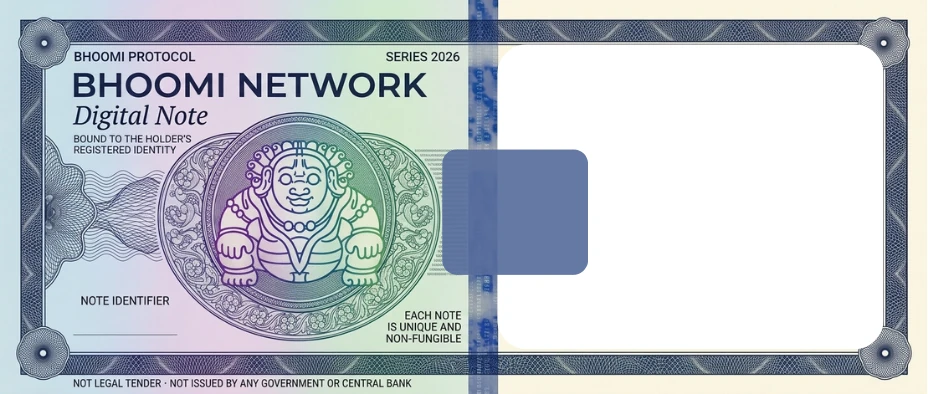
A Bhoomi Network Digital Note, Series 2026. A navy guilloché frame holds an iridescent panel with the deity mark in an engraved medallion, a security thread, a window, and a panel for the owner's artwork. Printed on it: "Bound to the holder's registered identity", "Each note is unique and non-fungible", and "Not legal tender · Not issued by any government or central bank".

Move the pointer over the note to tilt it.

The right-hand panel carries your own artwork. Choose it once, and every note you mint after that carries it.

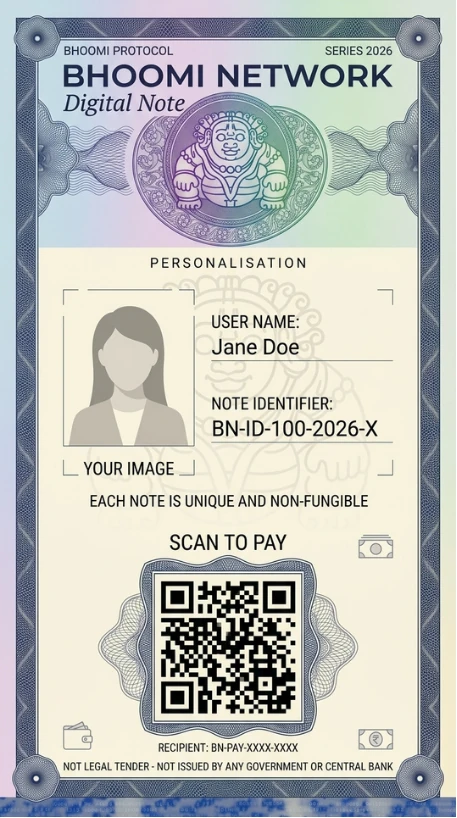
A Bhoomi Network printable ID in portrait format: the deity mark in a medallion, a photo, the user name and note identifier, "Scan to pay" above a QR code in a guilloché frame, and the line "Not legal tender · Not issued by any government or central bank".

A printable ID that can only pay you

Your member card carries your name, your photo and a QR code, and the QR can only pay you. Only you can print a card that scans: it carries a pay code signed by your node, and the pay page refuses a card without one.

Create a wallet, open your identity card, and print it.

Get your ID on testnet

A photograph of a note is worthless unless its claim code is showing.

15,417 mail-theft cheque fraud reports in six months. From 841 institutions, more than $688 million, United States.FinCEN, September 2024

We believe this is the first printable crypto-currency system. Founder's claim

Mint a note on testnet

Try it yourself

Services you can open today on the public testnet

Each card says how far along it is. Signed-in services start with a new wallet.

  • Live on testnet

    Wallet and payments

    Keys born in your browser and a seedless 2-of-3 backup. Send and receive test money person to person.

  • Live on testnet

    Peer-to-peer FX

    An order book between people. LKR/USD is live; any other pair is a configuration change.

    Open Create a wallet first, then open this.
  • Live on testnet · USDC pricing in progress · EURC planned

    Marketplace

    Buy and sell with settlement in BPU. USDC pricing is in progress; EURC is planned.

    Open Create a wallet first, then open this.
  • Live on testnet

    Printable notes and ID

    Money with a face value that you can print, and an ID card whose QR can only pay you.

    Open Create a wallet first, then open this.
  • Live on testnet

    Escrow

    Funds held until the terms are met, including release against trade documents.

    Open Create a wallet first, then open this.
  • Partial

    Exchange building blocks

    An order book, sealed-bid auctions and name claims.

    Open Create a wallet first, then open this.
Roadmap

Next on the roadmap, not live yet Document witness (Sākshi), offline hand-off and 10-country remittance.

"Live on testnet" means test money on a public test network. Nothing here is a financial service or an offer.

For institutions and regulators

The evidence comes with the payment

Regtech-native

The evidence a supervisor needs is produced by the protocol itself: signed receipts, double-sign proofs, certificates and a declared configuration.

Embedded-finance-native

Any app originates payments, escrows, notes and orders through one mechanism.

446 declared security settings. Strict mode: the node refuses to start if one differs.

1 posture divergence(s) and BHOOMI_POSTURE_INTENT_STRICT=1 — refusing to boot

Illustration of the refusal a node prints when one declared setting differs. · Code extraction report, 24 Sep 2026, E-M7

Where it runs

Built in Sri Lanka, for anywhere

Sri Lanka is where Bhoomi was built and first proved. The protocol has no home market; a new currency pair or corridor is a configuration change.

Sri Lanka · proving groundLKR/USD · live on testnet

6.49% global average cost of sending money home (banks: 14.55%). Q1 2025. The Sustainable Development Goal target is 3% by 2030.World Bank, Remittance Prices Worldwide

Why Bhoomi exists

It started in the Monaragala High Court.

I was leading the evidence of a little girl — a long, painful day that kept the court sitting until four in the evening. As we finished, her mother came to me quietly and asked whether we could take her evidence that same day too. The judge saw her speaking to me and asked what was wrong.

She earned a daily wage, she said. Every time she came to court she borrowed about 4,000 rupees from the village loan shark — money to leave one child at a relative's house with food, and to cover the journey and the day's meals. If she had to come back another day, she would never get out from under the debt.

The judge and I finished her evidence that day. And then we started a small fund — for the mothers and children who came to court with nothing to eat and no way home.

That fund was the first Bhoomi.

The loan shark was there. The bank was not. I've been building the system that should have been there ever since — credit, insurance, settlement, identity — infrastructure that shows up by default, so it never again depends on two exhausted people deciding to care.

— Gayan Lakpriya Perera, founder, Bhoomi Network
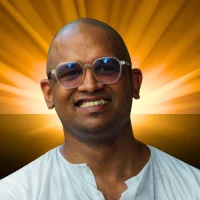
The team

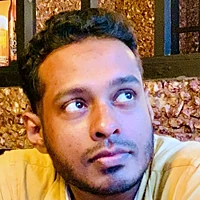
Gayan Lakpriya Perera (G.L. Perera)

Gayan Lakpriya Perera (G.L. Perera)

Founder & Chief Architect

  • Attorney-at-Law.
  • Seven years State Prosecuting Counsel at the Attorney General's Department of Sri Lanka: 3,000+ matters across 10 High Courts.
  • LLB (Hons), University of London.
  • USAID-trained in SGBV and human-trafficking law.
  • Founder, Policy Pillar.
  • Regulatory Strategy Lead, 150 MW solar consortium.
  • About two years building Bhoomi.
Dr. Praveen De Silva

Dr. Praveen De Silva

Co-Founder, Bhoomi Network · Founder & CEO, BeeSmart (Pvt) Ltd

Praveen is a technology entrepreneur, software architect, researcher and business leader with over a decade of experience delivering innovative software across healthcare, logistics, artificial intelligence, cloud computing, IoT and decentralized technologies.

  • 10+ years delivering software across healthcare, logistics, AI, cloud, IoT and decentralized systems
  • Founder & CEO, BeeSmart (Pvt) Ltd — enterprise software, AI platforms, medical technologies, cloud-native systems
  • MBA · BSc (Hons) Information Technology · Diploma in Law
  • Doctor of Business Administration (DBA) candidate, Girne American University
  • Co-Founder, Chef Tharu Restaurant Chain

Awarded an Honorary Doctorate by Washington Digital University in recognition of professional contributions to technology and innovation. This honorary recognition acknowledges professional achievement and is distinct from an earned academic doctorate.

Recognition

NBQSA Winner of Best Research and Development Project

National ICT Awards NBQSA 2026. Awarded 25 Sep 2026 to the entry "Bhoomi", entered by BeeSmart IT. · Award certificate

Roadmap

Where it goes next

Live on testnet

Public testnet

Live today at testnet.bhoomi.network.

Next

Mainnet

In the founder's words, "within weeks".

Then

The next proofs

  • An independent review
  • A second corridor
  • Crediting gated on a certificate
  • A published SDK and sandbox

Find your way in

Use it

Create a wallet on the public testnet and send your first payment.

Open the testnet

Build on it

Talk to the people building it on Discord.

Join the Discord

Invest or partner

Book a meeting with the founder.

Book a meeting

Press

Logos, the fact sheet and the boilerplate.

Press kit

Book a meeting with the founder

Pick a time and tell us what you would like to discuss. Every request is confirmed by email. Times are Sri Lanka time (GMT+5:30).

Get the updates

Milestones and releases, by email. Nothing else.

Questions, answered

What is Bhoomi?

A payment protocol and a set of services built on it. A payment commits with its owner's signature alone, every batch is ordered from signed content, and a seven-member committee certifies away from the payment path for recipients who need finality.

What is Bhoomi not?

It is not a blockchain with one global block order, not a mining or staking network, and not an investment product.

What are BPU, BNS and UTU?

BPU, BNS and UTU are the three units the protocol uses. On the public testnet they are test units with no monetary value, and none of them is sold or offered as an investment. How they work at mainnet will be published with the mainnet documents.

Where does the money sit?

On the testnet, balances are test balances recorded in the protocol's own ledger on each node. No real money is involved.

What is not built yet?

No independent audit yet. Node-side crediting gated on a certificate is not built. Trading venues are sequenced by a trusted custodian. The SDK and sandbox are not published.

How can I check your claims?

Every figure on this page shows its conditions and its source beside it. The code is Apache-2.0. A paper on the accountability and ordering layer is under double-blind peer review.

What does "Bhoomi" mean?

Bhoomi (භූමි / பூமி) means land, the earth itself. It is the oldest asset in the world and the one most people already understand and trust.

Can I try it?

Yes. The public testnet runs at testnet.bhoomi.network. Create a wallet in your browser and send a payment.

භාෂාව තෝරන්න · மொழியைத் தேர்ந்தெடுக்கவும் · Choose your language